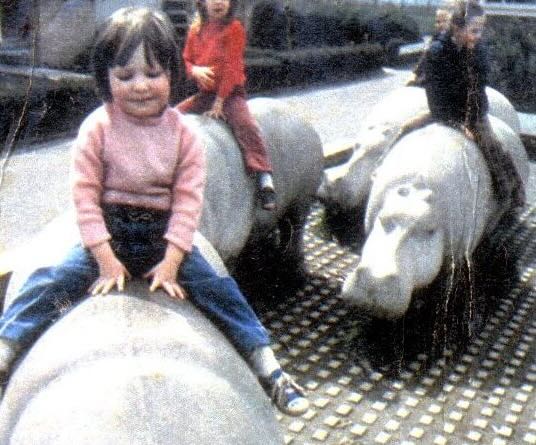
A couple of weeks ago Artist Lucy Grainge responded to our Earth Day post with a recommendation.
Published date: 07 May 2026
It was to watch the documentary ‘Meet You at the Hippos’. So, we did.
A personal and cultural journey through Scotland’s new towns, the programme follows actor Mark Bonnar as he explores the groundbreaking public art created by town artists, including his father Stan Bonnar, during the 1960s, 70s and 80s. Through sculptures embedded within everyday streets and neighbourhoods, the documentary reveals how the new towns transformed ideas about public art: creating works not for galleries or plinths, but for the communities who lived alongside them.
What struck us most was how integrated artists were within the development process itself.
As part of the new towns programme, artists-in-residence worked alongside architects, planners and landscape architects from the outset. Accommodation and studio space were often provided, sometimes within the construction compounds themselves. While there was rarely a formal budget for artworks, artists were encouraged to work with surplus construction materials left over from the building programme.
In many ways, it feels remarkably ahead of its time.
With the UK government now progressing plans for seven proposed new towns in England as part of its ‘next generation of new towns’ programme, it raises an interesting question: what would happen if artists-in-residence were embedded into these developments on a national scale?
The legacy of the Scottish new towns suggests the impact could be significant. The artworks became landmarks, play spaces and meeting points, helping shape identity, memory and belonging within the new communities forming around them. Many are still cherished today.
At the same time, the documentary sparked another thought for us. Public art is still rarely included in wider conversations around sustainability and materials, despite having huge potential to contribute to both.
Many of the new developments now coming forward will involve brownfield regeneration and demolition. Too often, existing materials are treated simply as waste to be cleared away. But what if they were viewed instead as resources with both material and cultural value?
This is where circular economy thinking connects naturally with public art and placemaking.
Reusing materials within public art not only avoids the environmental impact of manufacturing new products, it can also retain traces of a site’s history and identity, allowing artworks to carry stories forward into new communities.
This matters because the built environment accounts for around 40% of global carbon emissions, while the construction sector produces more than 60% of UK waste. With the sector expected to make major carbon reductions by 2030–2035 on the path to net zero by 2050, sustainability can no longer be something considered later in the process.
It needs to be embedded from the very beginning of design and planning.
Perhaps that is where the next generation of new towns has an opportunity to learn from the past: including artists not as a tick box for planning at the end, but as part of the conversation from the start.
Photo by kind permission of Stan Bonnar